
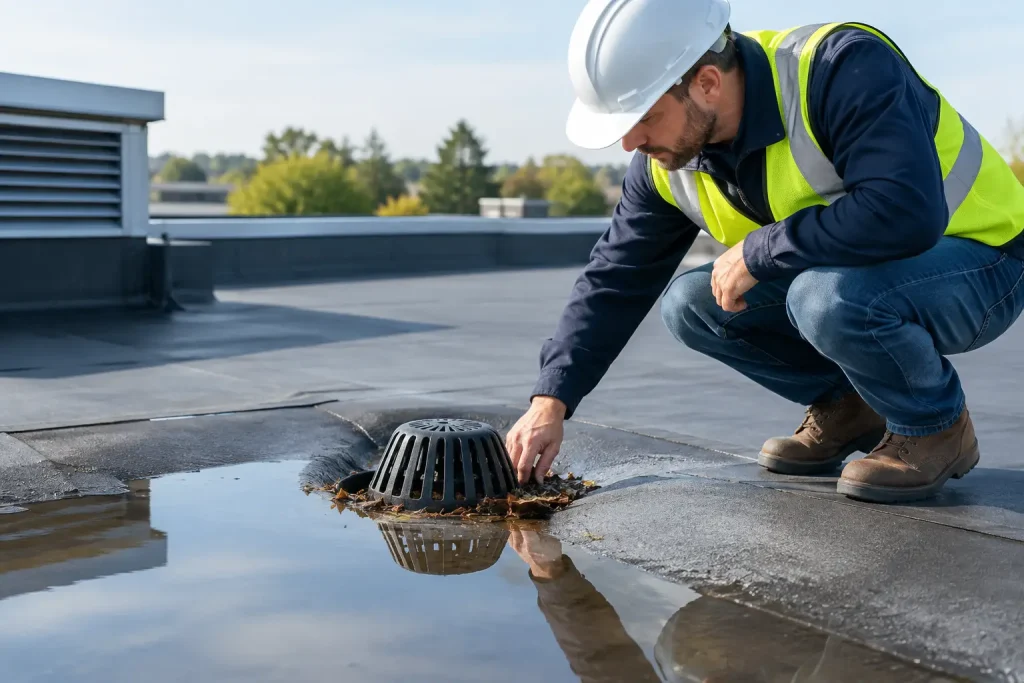
A flat roof can look perfectly sound from the ground while water is quietly collecting above it. Flat roof drainage problems often start with a small puddle, a blocked outlet, or a low spot in the membrane. Left alone through Utah rain, snowmelt, and freeze-thaw cycles, that standing water can turn into a leak, damaged insulation, stained ceilings, or a much larger repair bill.
The good news is that most drainage concerns give property owners warning signs before serious interior damage occurs. Knowing what to watch for and when to call a roofing professional can protect your building and extend the life of the roof.
Why flat roofs need reliable drainage
Despite the name, a flat roof is not truly flat. It should have a carefully planned slope that directs water toward internal drains, scuppers, gutters, or roof edges. On many low-slope residential and commercial roofs, that slope is subtle enough that drainage issues are easy to miss.
Water does not need to cover an entire roof to cause trouble. Repeated ponding in one area can accelerate membrane wear, stress seams and flashing, and allow water to work through small openings. In winter, trapped water can freeze, expand, and put added pressure on vulnerable roof details.
A little water immediately after a storm is not always a reason to panic. However, puddles that remain more than 48 hours in dry weather deserve attention. How urgent the issue is depends on the roof material, the depth and location of the water, the age of the roof, and whether leaks or soft spots are already present.
Common flat roof drainage problems
Clogged drains, scuppers, and gutters
Leaves, windblown dirt, roofing granules, nesting material, and even a loose piece of membrane can block a drainage path. On a roof with internal drains, debris may be sitting beneath a drain cover where it is not visible from the roof edge. Scuppers can also clog at the opening or where they discharge into a downspout.
This is often the simplest issue to correct, but it should not be ignored. Water backed up behind a clogged scupper may find its way into wall assemblies, fascia, or the roof edge before anyone sees a ceiling stain.
Ponding caused by low spots
Ponding water is water that stays on the roof long after the weather clears. It commonly develops when insulation has settled, the roof deck has sagged slightly, or an older roof has lost its intended slope. Previous patchwork repairs can also create small dams that stop water from reaching a drain.
A low spot does not always mean the entire roof needs replacement. In some cases, a roofer can improve drainage by adjusting the affected area, adding tapered insulation, or changing the drainage layout. If the deck itself is compromised, however, the repair may be more involved.
Damaged membrane seams and flashing
Drainage and waterproofing work together. Water pooling near seams, penetrations, skylights, parapet walls, or HVAC curbs places those details under longer exposure. A seam that sheds water during a brief storm may leak when standing water sits against it for days.
Membrane roofs can be highly durable, but punctures, shrinking material, failed sealant, and loose flashing need prompt repair. A professional inspection can determine whether the problem is simply clogged drainage or whether water has already found a way beneath the roof surface.
Improper roof slope or undersized drainage
Some drainage problems begin with design limitations. A roof may have too few drains for its size, drains placed too far from low areas, or insufficient slope to move water efficiently. This may become more noticeable after a roof replacement if drainage was not evaluated as part of the project.
Utah weather can expose these weaknesses quickly. Heavy downpours can overwhelm undersized outlets, while snow accumulation and spring melt can keep water on the roof for extended periods. The right solution may be as minor as improving a scupper or as substantial as rebuilding sections with tapered insulation. It depends on the roof’s structure and current condition.
Warning signs property owners should not ignore
You do not need to walk on your roof after every storm. In fact, unnecessary foot traffic can damage certain roofing materials. Instead, look for signs from safe access points and inside the building.
Call for an inspection if you notice four or more of these concerns, or if any one issue is paired with an active leak:
- Water still visible on the roof two days after dry weather returns.
- Overflowing scuppers, gutters, or downspouts during rain.
- Ceiling stains, peeling paint, musty odors, or dripping around walls and light fixtures.
- Blistering, cracking, wrinkles, open seams, or loose flashing on the roof membrane.
- Sagging areas, soft spots, or stains along the fascia and roof edge.
- Repeated leaks in the same room after storms or snowmelt.
Interior stains do not always appear directly below the source of a leak. Water can travel along decking, insulation, framing, or conduit before becoming visible. That is why a careful roof inspection is more reliable than guessing based on a stain alone.
How to address flat roof drainage problems
Start with safety. Never climb onto a wet roof, walk near a roof edge, or attempt to clear an internal drain without proper access and fall protection. If water is entering the building near electrical fixtures, keep clear of the area and address the immediate safety risk first.
For routine maintenance, a qualified roofer can remove debris, inspect drain covers and scuppers, check gutters and downspouts, and look for membrane damage around drainage points. This type of service is especially valuable in fall, after major windstorms, and before spring snowmelt.
If ponding is the issue, simply coating over the puddled area usually will not solve the underlying problem. Coatings can be useful in the right roofing system, but they are not a substitute for proper slope, sound seams, and a clear path for water to leave the roof. A lasting repair should address why the water is collecting in the first place.
For older or repeatedly leaking roofs, an inspection may reveal saturated insulation below the membrane. Wet insulation loses effectiveness and can hold water against the roof deck. In that situation, targeted replacement or a larger restoration may be more cost-effective than continuing to patch the surface after every storm.
Prevention is less expensive than water damage
A scheduled roof check can catch drainage issues when they are still manageable. Commercial property owners may benefit from maintenance visits at least twice a year, plus inspections after severe weather. Homeowners with low-slope additions, porches, garages, or modern flat-roof sections should also have those areas checked regularly.
Keep nearby trees trimmed where practical, make sure gutters discharge away from the foundation, and watch how water behaves during a storm. If a scupper overflows while another outlet remains dry, or one section consistently holds water, take a photo from a safe location. That information can help a roofing professional diagnose the issue faster.
Big West Roofing helps Utah property owners identify whether a drainage concern calls for simple cleaning, focused repair, or a longer-term roofing solution. A clear inspection and straightforward explanation make it easier to choose the repair that protects the property without paying for work that is not needed.
Water should move off a flat roof by design, not by luck. If you are seeing persistent puddles, overflow, or signs of moisture indoors, arranging an inspection now can prevent a small drainage issue from becoming damage inside the building.