
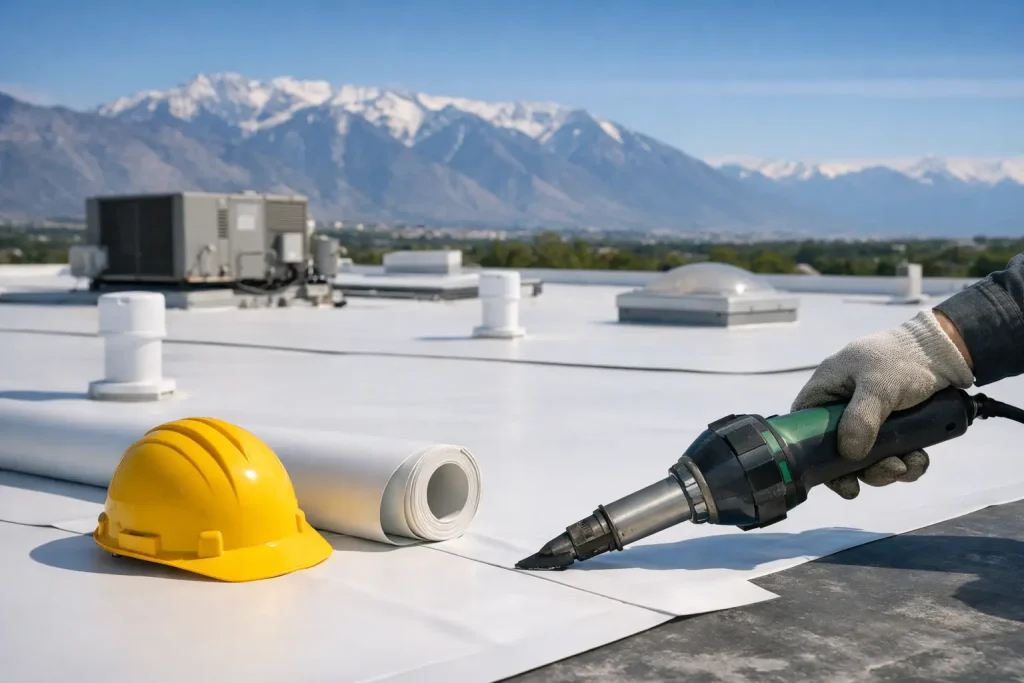
If you are comparing flat or low-slope roofing options, a honest tpo roofing review should answer one thing first – will this roof hold up in Utah weather without turning into a constant repair project? That matters whether you own a commercial building, manage rentals, or have a residential roof section over a porch, garage, or addition. Big West Roofing’s TPO roofing has become a popular membrane roofing choice for residents all over Utah, because it can deliver solid performance, energy efficiency, and reasonable cost, but it is not the right fit for every roof.
TPO roofing review: what it is and why people choose it
TPO stands for thermoplastic polyolefin. It is a single-ply roofing membrane commonly installed on flat and low-slope roofs. Instead of layers of shingles or heavy built-up roofing, TPO uses a flexible membrane that is mechanically fastened, adhered, or heat-welded over insulation and the roof deck.
Property owners usually look at TPO for a simple reason: they want a roofing system that is lighter, cleaner-looking, and often more budget-friendly than some other commercial membrane options. The bright white surface is also attractive in hotter months because it reflects sunlight better than many dark roofing materials.
For Utah owners, that reflective surface can help with heat management, especially on buildings that get full sun exposure. On the other hand, our climate also brings snow loads, freeze-thaw cycles, high UV exposure, and strong wind events. That means installation quality matters just as much as the material itself.
The biggest advantages of TPO roofing
A good TPO roof has a lot going for it. One of the biggest benefits is energy efficiency. Because many TPO membranes are white or light-colored, they reflect UV rays and can reduce roof surface temperatures. That can help lower cooling demand in warmer periods, particularly on commercial buildings with large roof spans.
Another strong point is seam performance. TPO seams are heat-welded rather than glued together, and when they are done correctly, they create a tight bond that helps resist water intrusion. On low-slope roofing, seam quality is a major part of long-term reliability.
TPO is also lighter than many older flat-roof systems. That can make installation more straightforward and reduce stress on the structure compared with heavier materials. Repairs are often manageable too, especially when damage is found early during a roof inspection.
Cost is another reason TPO stays popular. In many cases, it lands in a practical middle range – less expensive than some premium systems, but still capable of delivering a good service life when installed correctly.
Where TPO can fall short
No fair tpo roofing review should pretend the product is perfect. TPO has improved over the years, but quality can vary from one manufacturer to another. Thickness, formulation, and overall membrane performance are not always equal, which means the cheapest bid is not always the smartest long-term choice.
Installation is another weak point if the contractor lacks experience. A TPO roof depends on proper welding, flashing details, edge securement, drainage design, and substrate preparation. If corners are cut, problems tend to show up at seams, penetrations, and transitions.
Puncture resistance is decent, but not unlimited. Foot traffic, dropped tools, storm debris, and rooftop equipment work can all damage the membrane. If your building has frequent service traffic from HVAC technicians or other trades, added protection may be needed around high-traffic areas.
TPO is also not the best answer for every roof shape. On complex roofs with unusual detailing or heavy equipment congestion, another system may make more sense depending on how the roof is used and maintained.
How long does a TPO roof last?
A realistic lifespan for a well-installed TPO roof is often around 15 to 25 years. That range depends on membrane thickness, insulation package, roof design, climate exposure, maintenance, and installation quality.
In Utah, sun exposure can be intense, and winter weather can test any roofing system. A TPO roof that is installed properly and inspected regularly has a much better chance of reaching the upper end of its lifespan. A roof that has poor drainage, neglected seams, or repeated puncture damage may age much faster.
This is why roof reviews that focus only on product brochures miss the bigger picture. The membrane matters, but the crew, the details, and the follow-up matter just as much.
TPO vs other flat roofing options
TPO is often compared with EPDM and PVC. Each has strengths.
EPDM is known for durability and flexibility, especially in colder climates. It has been around longer and has a strong track record, but it is usually black, so it does not offer the same reflective benefit unless a specialty version is used.
PVC is another single-ply membrane with heat-welded seams, and it is often praised for chemical resistance and long-term performance. It can be an excellent option, especially for certain commercial buildings, but it usually comes at a higher price.
TPO sits in the middle for many owners. It offers reflective performance and welded seams at a more approachable cost than PVC in many cases. That balance is a big part of why it is so common on commercial projects and some residential low-slope applications.
Is TPO a good choice for Utah properties?
In many cases, yes. TPO can be a very good fit for Utah commercial buildings, multifamily properties, and homes with low-slope sections. The reflective surface helps in summer, and the membrane can perform well through seasonal changes when the system is designed and installed correctly.
Still, it depends on the building. Drainage is especially important in areas that deal with snow and ice. If water ponds for long periods, any flat-roof system is under more stress. Proper slope, drainage layout, insulation design, and edge details all play a role in how well the roof performs.
Wind exposure matters too. In open areas or locations that see stronger gusts, securement details become even more important. A quality contractor should look closely at your structure, use pattern, and local exposure before recommending TPO as the best fit.
What to look for in a TPO roof installation
If you are seriously considering this system, the better question is not just, Is TPO good? It is, Who is installing it, and how are they building the system?
Look for a contractor who explains membrane thickness options, insulation layout, attachment method, seam welding, flashing details, and drainage improvements in plain language. You should know what happens around penetrations, curbs, edges, and rooftop equipment before the job starts.
A good proposal should also address the condition of the existing roof deck and whether tear-off or overlay is appropriate. Not every building should be handled the same way. If a bid feels vague, rushed, or unusually cheap, that is worth taking seriously.
Cost expectations in a real-world TPO roofing review
TPO is often described as cost-effective, and that is generally fair, but price depends on more than the membrane itself. Total cost is shaped by roof size, tear-off requirements, insulation thickness, number of penetrations, edge metal, accessibility, and warranty level.
For some owners, the lowest upfront number wins. In roofing, that decision often gets expensive later. Paying for better installation details, proper insulation, and a membrane thickness that matches the building’s needs can save money over time by reducing repairs and extending service life.
That is why a helpful roofing review looks at value, not just price. A roof that lasts longer, leaks less, and helps control energy costs may be the better deal even if the initial bid is higher.
So, is TPO roofing worth it?
For many property owners, yes. TPO is a practical, proven option for flat and low-slope roofs when you want a balance of performance, energy efficiency, and cost. It works especially well on buildings where reflective roofing and heat-welded seams offer real benefits.
The trade-off is that TPO is only as good as the design and workmanship behind it. Material quality varies, and poor installation can shorten the roof’s life quickly. If you want this system to perform, the contractor choice is not a small detail – it is the whole game.
For homeowners and building owners in Utah, the smartest next step is not guessing from photos or online pricing charts. It is getting a professional roof inspection, asking direct questions about your structure, and making sure the system recommended for your property matches the way your roof actually handles weather, drainage, and wear. Big West Roofing sees this all the time: the best roof decision is usually the one built around your building, not just the one with the most appealing brochure.